
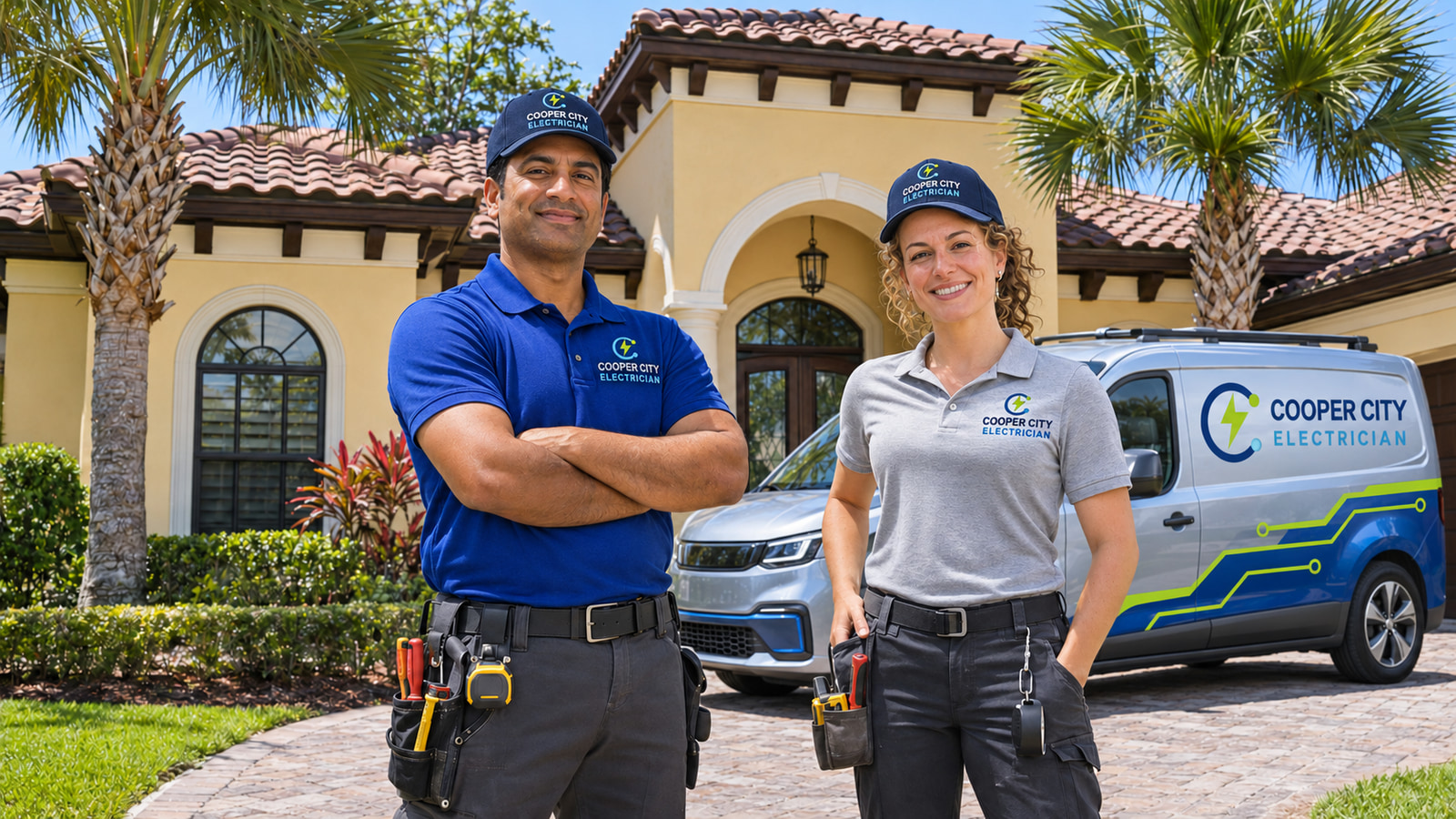
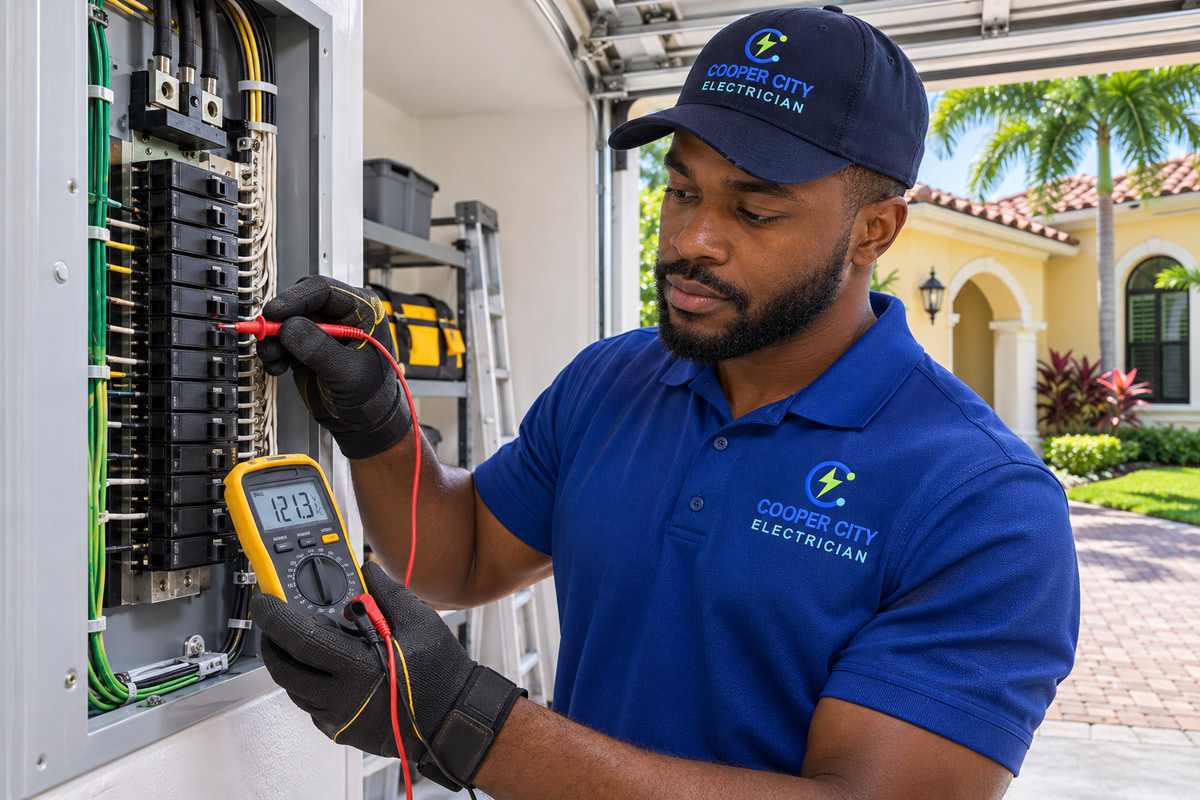
The shape of a family oriented suburb
Cooper City is a suburb in Broward County that people often describe by what it offers families: parks and ball fields across the city, schools, quiet residential streets and a steady stream of weekend activity. Flamingo Road and Sheridan Street are the main roads, and the neighborhoods arrange themselves around them. Most of the homes are single family houses, and most were built from the 1970s onward. That timeline matters to an electrician, because it tells us which materials, standards and habits shaped the wiring behind the walls.
A family suburb creates predictable patterns of use. Mornings are busy: alarms, hair dryers, coffee makers, toasters and chargers all come on within an hour. Afternoons bring homework, laptops, game consoles and the air conditioner running its hardest. Evenings add cooking, laundry, television and the pool pump. Weekends bring guests, gatherings and outdoor equipment. Unlike a business with a steady load, a household has peaks, and the peaks are what stress the system.
What sets Cooper City apart is how consistent these patterns are across the city. A street in one part of town looks much like a street in another: a garage, a front entry, a lanai at the back, a back yard that often has a pool. Because the housing is similar, the electrical questions are similar, and a good understanding of those questions benefits nearly everyone. At the same time, no two houses are identical, and every house has been changed by its owners over the decades. A kitchen remodel here, a garage conversion there, a new air conditioner, a pool added after the house was built.
That is why we avoid assuming. We start by hearing what you notice, then look at what the house actually has. The sections below describe the broad picture: the age of the homes, what children and teens add, the outdoor features that define local living, and the effects of additions and storm seasons.
If you want to read about a particular part of the city, the other pages on this site describe neighborhoods and corridors, including Embassy Lakes, Rock Creek, Monterra, the Flamingo Road and Sheridan Street corridors and the area around Brian Piccolo Park. This page is the overview that ties them together.
Homes from the 1970s onward and what their wiring tells us
The age of a house is a rough guide to its electrical system. Homes built in the 1970s generally predate many protections that are now standard. Over the following decades, requirements expanded to include ground fault protection in more locations, arc fault protection in living spaces, tamper resistant receptacles, smoke alarm interconnection and more demanding rules for grounding and bonding. A house built in the 1970s and never updated may lack some of these, while one built more recently probably has them.
That does not mean older homes are unsafe, only that they deserve a look. Many houses from the 1970s onward have wiring that has served well for decades. The signs we pay attention to are specific. Outlets that no longer hold plugs firmly. Two prong receptacles in older rooms. Switches that crackle or feel warm. A panel from the era of the house that has seen additions without upgrades. Breakers of a type known to have problems in some brands. Aluminum branch wiring, which was used in some homes built in the early 1970s, and which requires special attention at connections. We do not assume any of these exist in a given home, but we know to check.
Construction type also matters. Many local homes are built of concrete block, which affects how new wiring is run. Running new wire in block walls usually means going through the attic and down, or using surface conduit where needed, or cutting channels, and each approach has tradeoffs for appearance and cost. A good plan considers the layout before any hole is made.
Newer homes, those built in the 1990s and later, usually have more modern panels and wiring, with more circuits and better protection. They have their own questions, such as nuisance tripping of arc fault breakers, limited remaining capacity in the panel and the need to add chargers and outdoor equipment.
Across all ages, a useful starting point is a look at the panel. Is it clean and labeled? Does it have room? Are there signs of heat or corrosion? Is the main breaker sized for the loads? A short evaluation answers these questions and gives you a clear picture of where you stand. We can talk through what such an evaluation involves by phone.
Permits and inspections may apply to electrical work, and the city permit office is the right place to confirm what is required. A licensed professional should confirm code questions for your home.
Consider a worked example from a typical street. A house from the late 1970s has its original panel, a kitchen that was remodeled once, and a pool added in the 1990s. The owner calls because the lights dim when the air conditioner starts and the kitchen breaker trips when the microwave and toaster run together. A visit shows the panel is sound but crowded, the pool equipment is on a circuit that also feeds the garage, and two kitchen outlets share a line with the dining room. The remedy is a handful of well chosen changes, a new kitchen small appliance circuit, a separate pool circuit and a tidy directory, not a complete replacement. That kind of measured answer is what we aim for.
Another example is the house that has been rented out for a few years. Tenants come and go, and each leaves behind a little more wear. Loose outlets, cover plates cracked by furniture and a smoke alarm that someone silenced all add up. A planned walk through between tenants, checking every outlet, switch, alarm and the panel, catches these problems early and costs little.
Kids, teens and the electrical load they bring
No part of a household changes its electrical needs more than the arrival and growth of children. A newborn brings a nursery with a monitor, a white noise machine, a night light and perhaps a bottle warmer. A toddler brings the need for outlet covers and cord management. A school age child brings a computer, a tablet and a desk lamp. A teenager brings a game console, multiple screens, a speaker, a hair styling kit, a mini fridge and chargers for everything. The bedroom circuit that suited a quiet adult now carries a lot.
Childproofing is the first concern. Modern outlets that are tamper resistant have shutters that block objects not shaped like a plug. These are required in new construction and are a good upgrade in older rooms where children play. Cords should be short and kept out of reach, and furniture should not trap them against walls where they can overheat. Loose cord ends and damaged cords should be replaced right away.
For teens, the main issue is load and habits. A bedroom with many devices on power strips and a ceiling fan can overload a circuit, especially when a space heater or hair appliance is added. Signs include a warm power strip, a breaker that trips at night and flickering lights. Adding outlets, putting a heavy appliance on its own circuit, or moving some of the bedroom load to another line solves these problems. It also helps to teach teens basic electrical safety: do not overload strips, do not use damaged cords, do not run cords under rugs, and do not charge large batteries in bed.
Some features of family life worth planning for:
- A home office or study nook with enough outlets and a good light.
- A homework area in the kitchen or dining room with charging outlets.
- A game room or media space with circuits that can handle several devices.
- A laundry area that can handle frequent loads of sports clothing.
- A charging station for scooters, e bikes and phones, placed in a safe location.
When grandparents visit, they may bring medical devices or have mobility needs. Lighting on stairs and halls, night lights in bathrooms and easily reached switches all improve safety. A conversation about these small matters is part of what a family oriented electrician can offer.
Each of these topics has more detail on the guides section of this site. This page offers the summary: a family's electrical life is dynamic, and good wiring adapts to it.
Pools, lanais and garages: the three spaces that define local living
If you ask what shapes electrical work in Cooper City, three spaces come up again and again: the pool, the lanai and the garage. Each is a place where families spend time, and each puts specific demands on wiring.
The pool is the most safety critical. Pumps, lights, heaters and cleaners run on circuits that must be protected against leakage and properly bonded. A pool that trips breakers is not something to ignore or bypass. The cause could be a motor, a connection or moisture, and the answer is to find out. Pool lighting, bonding and wiring have special rules, and a licensed professional and the city permit office should confirm what applies.
The lanai is the living room of the outdoors. Ceiling fans, lights, outlets and sometimes a television or speakers make it a pleasant place, but the wiring there lives in a damp environment. Fixtures and devices should be rated for damp or wet locations. Outlets should be ground fault protected with covers that protect when a cord is plugged in. Fans need boxes rated to support them.
The garage is the working space. It holds the second refrigerator, the freezer, the tools, the washer and dryer in some homes, the panel in many, and the family cars. Garage outlets need ground fault protection. Freezers should be on circuits that will not be shared with tools. Lighting should be bright and on a separate switch from the outlets. Many families now plan for electric vehicle charging in the garage, which requires a dedicated circuit and available capacity in the panel.
Safety around generators also lives here. Generators must never run in a garage, even with the door open, because carbon monoxide can drift into the house. A carbon monoxide alarm near the door between the garage and the house adds a layer of protection. The best practice is to keep the generator outdoors, well away from windows, doors and vents.
Maintenance in these three spaces follows a simple pattern. Check outdoor covers each spring and fall. Test protective devices regularly. Keep the area around the panel clear. Watch for signs of moisture or corrosion. Do not use damaged cords. These small acts prevent big problems.
We cover each of these topics in more depth in our service and guide pages. For now, remember that these spaces shape the daily use of electricity in the city, and a good electrician pays attention to them.
It helps to think of the three spaces as one connected system. The pool equipment pad is often on the garage side of the house, the lanai circuits may share a panel with the garage, and a single failed connection in one place can show up as a symptom in another. When a lanai light flickers only when the pool pump runs, the shared circuit or a loose neutral may be the cause. Looking at the whole picture, rather than one symptom at a time, is how we sort these cases out efficiently.
Additions, renovations and the long storm season
Families in Cooper City tend to stay in their homes and adapt them. A bedroom is added for a growing family. A garage becomes a game room or an in law suite. A kitchen is renovated to suit a family that cooks together. An enclosed patio becomes a Florida room. Each project changes the electrical system, and the earlier electrical is considered, the better the result.
For any addition, three questions come first. Is there enough capacity in the panel and the service for the new load? Where will the new circuits run, and how will they be routed through existing walls, attic or slab? What do the permit and inspection rules require? The answers shape the cost and the schedule. A load calculation is the tool for the first question, a visit to the site answers the second, and the city permit office answers the third.
Renovations also uncover surprises. When a wall is opened, old wiring may be revealed that was not visible before. An experienced electrician will tell you what is found, explain whether it needs to be corrected and describe the options. It is better to correct problems while walls are open than after finishes are in place.
Then there is the weather. Hurricane season runs through much of the year's warm months, and South Florida homes need to prepare. Electrical preparation includes knowing where the main breaker is, understanding how to shut off circuits, having a plan for outages and checking that outdoor equipment is secure. After a storm, caution is key. Do not touch downed lines. Do not enter standing water near electrical equipment. Do not use water damaged appliances or outlets until they have been checked. Use generators safely and outdoors.
Power restoration can bring surges. Turn off major appliances before power returns and bring them back one at a time. A whole home surge protective device at the panel, with plug in protection at electronics, gives a layered defense.
Even outside of storm season, heavy rain and lightning can cause trouble. Lightning can send surges through lines, and a nearby strike can damage electronics even without a direct hit. Unplug irreplaceable equipment during close storms, and have your protective devices checked.
Planning for these realities is part of living here. Doing it before the season starts is far easier than doing it after.
How we work with a household, from first call to finished job
The way we work is simple, and it begins with a phone call. You tell us what you see, hear or smell, where in the house it happens and how long it has been going on. We ask questions. Is it one circuit or several? Does it happen at certain times? Has anything changed recently? These questions narrow the possibilities and help us decide how to proceed.
For simple repairs, we can often describe what to expect right away. A quote follows the phone conversation. For more complex work, such as a panel upgrade, a rewire, a renovation or an unexplained problem, we come to look at the house first. Wiring that you cannot see requires examination before it can be described accurately. We do not guess at prices or timelines in the dark.
When we visit, we explain what we find in plain language. We show you what we see when it can be shown. We describe the choices and what each involves, and we let you decide. If a repair is enough, we say so. If something is a safety issue, we say that too.
Preparation helps. Clear the area in front of the panel. Note where and when the problem occurs. Gather any paperwork on recent work. Have a list of questions. And think about your schedule, so we can plan around it.
After the work, we test, clean up and explain what was done. We update the panel directory. We note anything to watch for and anything you might want to plan for in the future. We encourage you to keep a record of what was done, which becomes part of the history of your home.
Our approach rests on a few principles:
- Listen first, and ask good questions.
- Explain in plain words, without pressure.
- Fix the cause, not just the symptom.
- Respect your home, your time and your family.
- Be honest about what needs a visit before a quote is possible.
If you live in Cooper City, whether near Flamingo Road or Sheridan Street, close to a ball field or tucked into a quiet street, we would be glad to hear what you need. Call, describe what is happening and let us help you work out the next step.
Neighborhoods and corridors across Cooper City
Cooper City is a family oriented suburb in Broward County, with parks and ball fields throughout and single family homes mostly built from the 1970s onward. Flamingo Road and Sheridan Street are the main roads. We serve the whole city, including communities such as Embassy Lakes, Rock Creek and Monterra, the corridors along the main roads and the area around Brian Piccolo Park. Each part of the city has its own character, from lakeside streets to newer developments to older neighborhoods, and each has its own page on this site.
Whatever the neighborhood, the homes share a common thread: families live in them, and the electrical system has to keep up with daily life.
Neighboring communities
Cooper City borders Davie, and we serve households and businesses there as well. The Davie, Old Davie and University Drive pages describe those areas. Southwest Ranches, with its large rural lots, is another neighbor. Each page is written for its own setting, and reading the one that fits your location will give you the most relevant detail.