

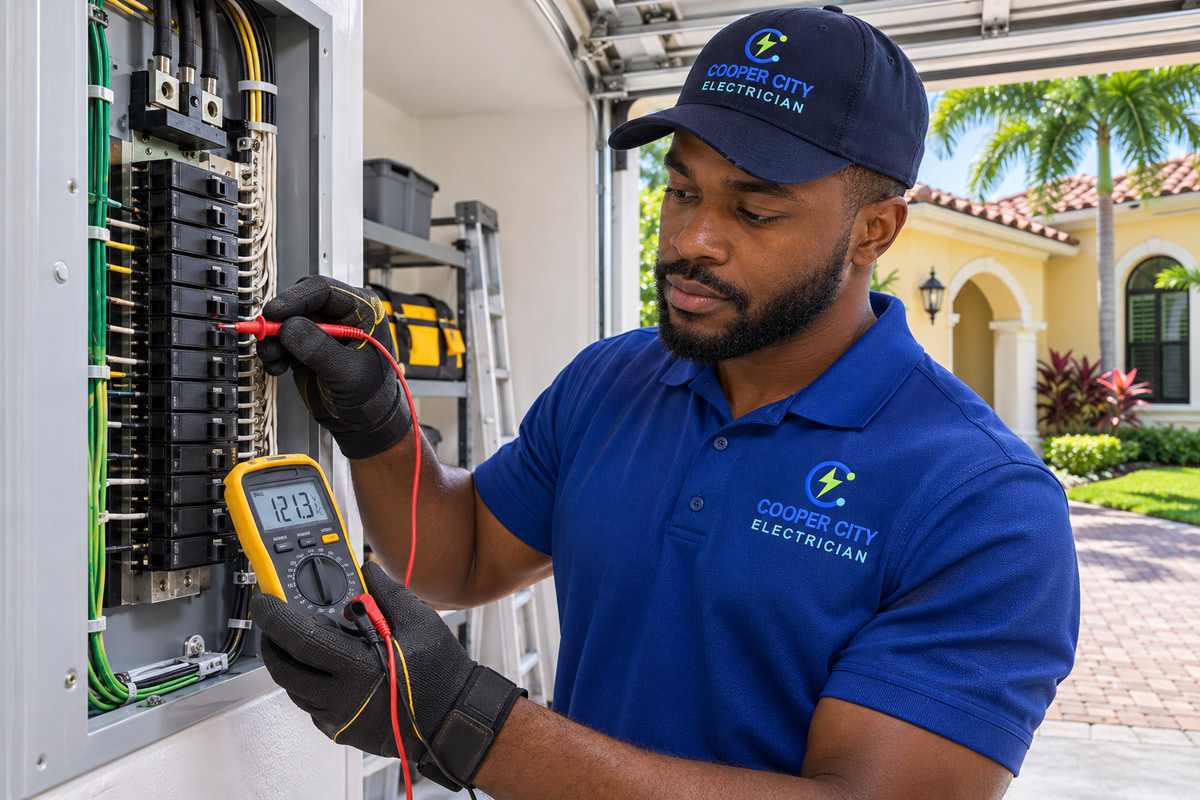
An area where homes and businesses sit close together
Some places are purely residential, and some are purely commercial. Pembroke Lakes is both. It is an area of Pembroke Pines where you find residential streets and also the kind of shopping and service activity that grows up around a major mall. Pembroke Lakes Mall is a well known nearby landmark, and the trade it draws brings a steady flow of stores, offices and restaurants into the surrounding area. The people who live nearby shop, eat and work in those same places.
That closeness shapes the electrical picture in a few ways. First, residents often know the businesses around them and sometimes own one. A homeowner may also run a small office, a salon, a studio or an online shop from a unit down the road. Second, the electrical systems of homes and small commercial spaces rely on the same basic principles, although the details differ. A circuit is a circuit, but commercial spaces may have three phase service, different lighting levels, larger loads and extra rules about emergency lighting and exits.
For the person reading this page, the key is to identify which situation applies. If you are a homeowner, the home section describes the usual questions. If you operate a small business or manage a rental space, the business section covers what differs. If you do both, you will find yourself reading across sections, and that is fine.
Whichever role you are in, the same calm approach works: describe the issue, share what you have noticed, and arrange a visit if the situation involves anything hidden. A short list of what is on a circuit, such as register, display lights, signage and a refrigerator, helps an electrician spot overload risks quickly. A short list of what a family uses, such as dishwasher, dryer and a home office, does the same at home.
This page avoids any promises about timing or price because both depend on what is found on site. What it does offer is a framework for thinking clearly, so that you can ask better questions and recognize a good answer when you hear one.
At home: busy streets, busy schedules
Homes near a major shopping area see a certain rhythm. Traffic patterns bring noise, and residents often have jobs in retail, healthcare, education or services, which means irregular hours. Electrical needs follow that rhythm. A household with someone who works nights may have appliances and cooling running at odd hours. A household with several drivers may want more than one charger. A household that often hosts family may need extra outdoor outlets and lighting.
Start with safety at home. Smoke and carbon monoxide alarms should be present and dated, with batteries replaced as recommended. Ground fault protection should be in kitchens, baths, garages and outdoors. Outlets should hold plugs firmly. These basics apply anywhere, and they are the right foundation before adding anything new.
Next, consider the convenience layer. Many residents in an area with frequent errands want smart controls for porch lights and security, so lights can come on when they are away. A photocell or timer on exterior lighting is an easy upgrade, and motion sensors can light driveways without leaving lights on all night. Doorbell cameras need power, and wiring for them is often a small job if a transformer already exists.
Then consider comfort. Air conditioning is the heaviest load in most homes, and an older system can draw more power than a newer one. If you are replacing an air conditioner, the electrical side matters: wire size, breaker size, disconnect and surge protection should be reviewed. The installer of the cooling equipment and the electrician should agree on specifications.
Finally, remember the possibility of storms. Thunderstorms are a regular feature of South Florida summers. The areas around malls have large parking lots and many metal structures, which can influence how storms behave, but it is safest to assume that any home can see surges. A panel surge device is wise, and a short list of what to unplug during a severe storm helps too. After a storm, if lights flicker or the power returns with an odd smell, shut off the affected circuits and call.
A home example illustrates the sequence. A couple in a house near the mall area both work irregular hours, and they have begun running the dryer and dishwasher at night to save time. Their breaker for the laundry area trips about once a week. Instead of guessing, the electrician asks about the pattern, then inspects the laundry circuit and the outlet behind the dryer. The cord plug is discolored, a sign of a loose connection that has been heating. The outlet is replaced with a heavy duty one, the cord is replaced, and the breaker is checked and found healthy. The tripping stops, and the couple learns what an early sign looks like. If the electrician had simply installed a larger breaker, the heat at the plug could have continued unnoticed. This is why the cause matters more than the symptom.
Homeowners near busy commercial areas also sometimes ask about the effect of nearby construction or large equipment on their power. Short flickers can come from many sources, including the utility's switching, and cannot always be solved at your end. What you can do is protect your equipment with a surge device and keep notes about when it happens. If the flickers coincide with certain hours, share that with the utility and your electrician. A pattern helps pin down whether the problem is inside your walls or outside them.
If you are a landlord with a rental house or a unit, remember that smoke alarms, ground fault protection and working lights are part of keeping a property safe for tenants. A yearly check of those items, with dates written down, is a good practice. Prompt repair of a reported problem protects the tenant and the property, and a record of that repair is a sensible thing to keep.
Small business space: what changes when customers walk in
A small shop, salon, office or restaurant has to meet needs that a house does not. Customers and staff are in the space, which raises safety expectations. Exits must be clearly marked and lit, emergency lighting must work when the power fails, and certain equipment needs dedicated circuits. The details are set by building and fire codes that your local authorities enforce, and an electrician working in commercial space will be familiar with the typical requirements. Always confirm the specifics for your own space with the local building authority.
The first practical matter is the panel and service. Commercial spaces often have three phase power, which is useful for larger motors and some equipment. Many small units still use single phase power, similar to a house. Before signing a lease or buying equipment, find out what service the space has, and whether the panel has spare capacity. A restaurant that adds a second oven or a salon that adds more dryers can exceed a space's capacity fast.
Next, look at the circuits for equipment. Refrigeration, ovens, dryers, display cases, point of sale systems and signs all have particular needs. Dedicated circuits protect equipment from interfering with each other and make it easier to find a fault. Label every circuit clearly, because staff other than the owner may need to reset a breaker in a hurry.
Lighting also matters more in business than at home. Retail spaces benefit from layered lighting that makes products look their best. Offices benefit from even, low glare light that keeps people comfortable. Restaurants rely on controls that change the mood between lunch and dinner. LED sources reduce heat and energy use, and dimming controls give flexibility.
Finally, think about the outside. Storefront signs, awning lights and parking lot fixtures need proper wiring, weather sealing and timers. A sign that goes dark at night undermines the business, and one that stays on all day wastes money. A lighting contactor or a smart timer can handle schedules reliably. For more on this topic, see our page on storefront signs and awning lighting, and our page on light commercial electrical work.
A worked example shows the thinking. Suppose someone is opening a small cafe in a unit that used to be an office. The space has a panel with plenty of lighting circuits but few circuits for equipment. The plan includes an espresso machine, a refrigerated display case, a reach in cooler, a small oven, a dishwasher, a menu sign and point of sale equipment. The electrician begins by asking for the nameplate information on each machine, which lists the voltage and current it needs. Adding those up shows that the espresso machine and the oven each want their own circuit, that the refrigeration should be on circuits that never share with heat producing gear, and that the service itself may be tight. The conversation then shifts to what the landlord allows, what the building authority needs to review, and how long the utility might need if the service must be increased. A visit confirms the real conditions, and only then is a quote built. The owner learns early which items are essential and which can wait for a second phase, so the opening is not delayed by a purchase that the space cannot support.
Offices and studios have their own twist. A small studio with several computers, monitors, lights and a kettle may be fine on paper but trip breakers in practice, because the kettle and a space heater share a wall with the computers. Splitting loads between circuits, placing the heavy appliances on a separate one and adding surge protection solves most of these cases. A tidy cable plan, with outlets placed at desk height and network jacks beside them, keeps floors clear and reduces trip hazards for clients who walk through.
Remember also that a lease usually defines who is responsible for what. Some landlords handle the panel and building wiring, while tenants handle everything past the panel. Read the lease or ask the property manager before arranging work, so you do not alter something that belongs to the building.
Lighting that works in both settings
Lighting is one of the most noticeable results of electrical work, and also one of the most commonly misjudged. People tend to think in terms of fixtures, but the real subject is light: how much, what color, from where and under what control.
Brightness is measured in lumens, not watts. Watts tell you how much power a bulb uses, while lumens tell you how much light it produces. With efficient bulbs, a low wattage can produce plenty of light, so look at lumens when choosing. A kitchen or workspace typically needs more light than a bedroom or hallway.
Color temperature is described in degrees, with lower numbers giving warmer, yellowish light and higher numbers giving cooler, bluish light. Warm light feels cozy and suits living areas and restaurants. Cooler light feels crisp and suits workspaces, garages and some retail. Mixing very different color temperatures in one room looks odd, so choose one family of color and stay with it.
Placement matters as much as power. A ceiling fixture alone makes shadows on faces and counters. Adding light at the sides or below, such as under cabinet strips or wall washers, reduces shadows and makes spaces feel larger. In a business, lighting products at an angle can highlight texture, while flat overhead light can make them look dull.
Controls give flexibility. Dimmers, timers, motion sensors and daylight sensors let a space change through the day and reduce energy use. Make sure dimmers match the bulbs. A dimmer designed for older bulbs may flicker or buzz with LEDs, and some LEDs are not dimmable at all.
Finally, think about maintenance. A fixture that needs a ladder and special tools to change will go unrepaired for months. Choose fixtures that are easy to service, and in high spaces consider long life sources. Emergency lighting in a business should be tested regularly, and a log of tests is a helpful habit. At home, a simple yearly walk around to replace tired bulbs and check fixtures for heat damage goes a long way.
Power quality: when electronics need extra care
Modern life depends on sensitive electronics, and sensitive electronics depend on clean, steady power. In both homes and small businesses, a few simple measures protect equipment and prevent frustrating glitches.
First, protection from surges. A surge is a brief spike in voltage, often caused by lightning or by large equipment switching on and off. A surge protective device at the panel catches large spikes, and plug in protectors at individual devices catch smaller ones. Together they form layers. The protectors have a limited life and wear with use, so check any indicator light they have and replace them according to the maker's guidance.
Second, protection from outages. A brief loss of power can erase unsaved work, damage a drive or interrupt a sale. An uninterruptible power supply bridges short gaps and allows a safe shutdown. They are used widely for computers, routers and point of sale systems. Choose one rated for the load you plan to put on it, and test it occasionally.
Third, avoid sharing circuits with heavy loads. A printer, a microwave or a space heater on the same circuit as a computer can cause flickering or resets. Where possible, put sensitive equipment on a dedicated circuit, and keep motors and heaters elsewhere.
Fourth, grounding and bonding. Properly grounded circuits help protective devices work and reduce noise. In an older space, a missing or poor ground can cause odd behavior in electronics. An electrician can test for correct wiring with simple tools and correct what is found.
Fifth, cabling. Power and data cables should be separated where practical, and neat routing helps with troubleshooting. A tidy network closet with labeled cables, adequate ventilation and a dedicated circuit is far less likely to fail than a tangle behind a desk. If you are in a shared building, ask your landlord about access and rules for running new cable.
Finally, consider heat. Equipment that runs hot inside a closed cabinet needs ventilation. Overheated equipment fails early. If a closet is warm to the touch, add airflow, and check that the circuit is sized correctly.
Scheduling, access and keeping disruption small
Electrical work needs access to panels, walls and ceilings, and to power being off for periods of time. Good planning reduces disruption for families and for customers alike.
For a home, think about which hours are least disruptive. If someone works from home, schedule outages around meetings. If someone depends on medical equipment, tell the electrician in advance so that plans can be made. Move furniture away from the panel and from walls that will be opened, and put away fragile items.
For a business, think about opening hours. Some work can be done after closing or on a day when the shop is closed. Some work, such as panel replacement, requires a full shutdown, and the planning must include food storage, refrigeration, point of sale data and employee schedules. Notify landlords and neighboring tenants in advance when shared systems are involved.
Access matters too. In shopping areas, loading zones, parking and building management rules can affect when and how contractors arrive. Ask your property manager about rules for contractors, such as required paperwork, elevator reservations or hours when noisy work is permitted.
Permits and inspections add steps. Many projects need approval before work and inspection after. In a commercial space, additional reviews may apply, and the landlord may need to approve plans. Build time for these into your calendar and ask your electrician how they handle them.
Communication is the heart of a smooth project. Agree on who is the point of contact, how updates will be shared and what to do if something unexpected is found. Hidden conditions, such as an unlabeled circuit or an old splice in a wall, can change the plan, and the best response is a prompt, honest conversation about options.
Pembroke Lakes is an area where life moves fast, and electrical work should fit into that without causing stress. Call to describe your situation, whether it is a home project, a shop upgrade or both. A quote is given after a phone conversation, and a visit follows whenever the work involves a panel, hidden wiring or a commercial space. Cooper City, a family oriented suburb nearby, shares many of the same patterns of busy households, and what works in one often helps in the other.
The Pembroke Lakes area
Pembroke Lakes is an area of Pembroke Pines, and Pembroke Lakes Mall is a nearby landmark that many residents use to describe where they live. Around it you find a mix of residential streets, service businesses, restaurants and shops. People who live here often describe their location in terms of nearby roads and shopping areas, which is a helpful way to start a conversation.
When you call, mention whether the work is for a home or a business, how old the building is if you know, and any equipment that matters, such as ovens, dryers or a server closet. Those details point the first conversation in the right direction.
Nearby areas with their own pages
Close by are Silver Lakes and Chapel Trail, both in Pembroke Pines, and the main Pembroke Pines page covers the whole city. Cooper City is another nearby suburb. For charging at home or at a shop, see our page on EV charger installation, and for planning household loads, read how much capacity a growing family needs.