
A district with its own character
Drive along Davie Road and the feel of the place changes from the suburbs around it. Old Davie has a western theme, and the district is known for horse properties and larger lots. Buildings sit farther apart, yards are bigger and the scale of a property is different from the tight lots of a typical subdivision. Many owners care about their land, their animals and the character of the district, and that shapes how they approach their homes and outbuildings.
For an electrician, this kind of district is a lesson in variety. In a subdivision built in a short period, houses are alike and wiring is alike. In Old Davie, properties come from different periods, and many have grown in stages. A house may have been built in one era, extended in another and given a new kitchen in a third. A barn may have been wired once and modified several times. A guest cottage may be newer than everything else. The result is a patchwork, and the only way to understand a patchwork is to look at each piece.
That is why we avoid assumptions on these properties. We ask owners to tell us what they know about the history of the buildings. When was the house built, and was it ever rewired? Who did additions, and were they inspected? What buildings are on the property, and which of them have power? Where does power come from, and how far does it travel? Often owners do not know, and that is fine. We learn by looking.
A larger lot also changes the practical details. Wire runs are long, which affects wire size and voltage drop. Outbuildings need their own protection. Weather exposure is greater, with open yards where lightning and wind have more effect. Trees and fences sit near lines. Animals bring their own hazards. We keep all of these in mind.
Charm is part of the attraction of Old Davie, and we respect it. Updating wiring does not have to change the look of a place. Fixtures can be chosen to suit a rustic or western style, and conduit can be routed to avoid visible runs where possible. Safety and character can coexist.
Reading wiring of mixed ages without assuming
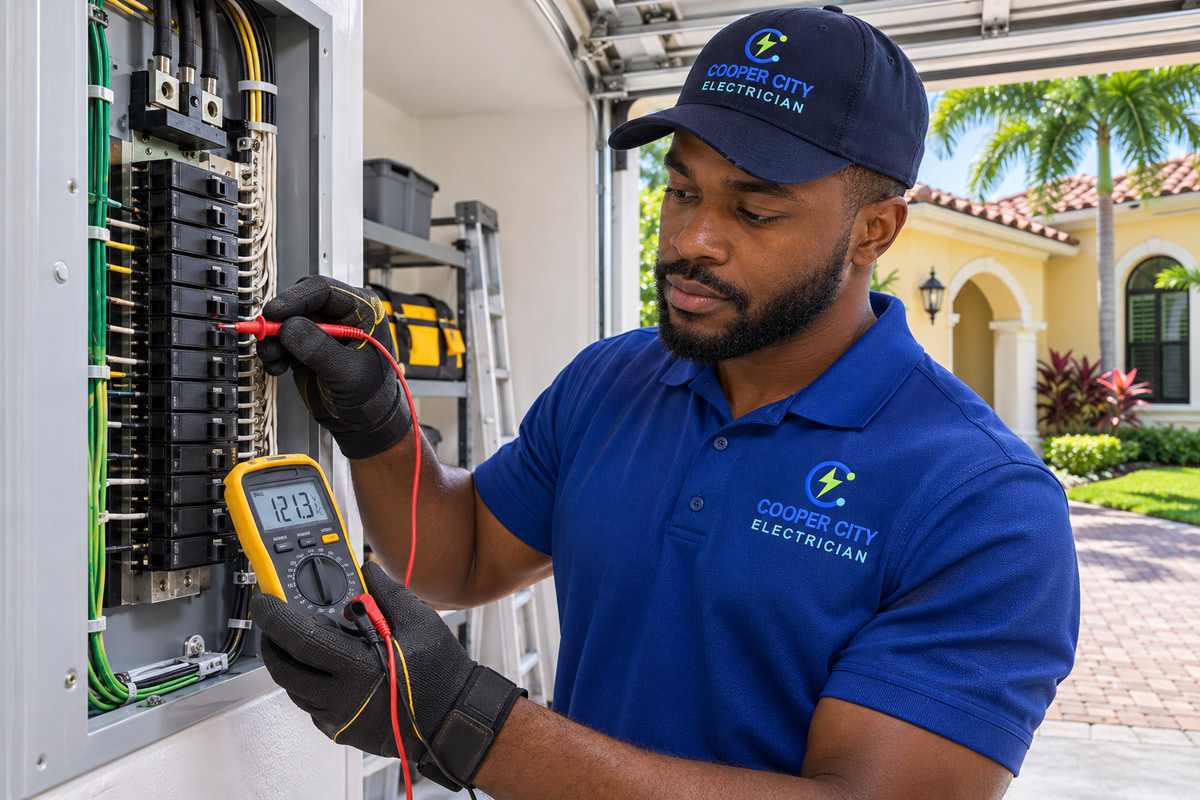
When we evaluate an older property, we begin with the panel, because it is the hub. We note its age, brand and condition, the size of the main breaker, the number of spaces and whether circuits are labeled. Some panels in older houses are small, with limited capacity, and some have had breakers added to the point of crowding. Others have been replaced and are in good shape. The panel tells a story, and the story guides the rest of the visit.
Next, we look at the types of wiring. Over the decades, houses have been wired with different materials. Early wiring may use cloth covered conductors that become brittle with age. Mid century houses commonly used nonmetallic cable with no separate ground in some applications. Some houses built in a certain period used aluminum branch wiring, which expands and contracts differently from copper and needs special connectors. Later houses use copper cable with a ground. We cannot tell by looking at the outside of a house which of these is inside, and we do not guess. We look at accessible points, such as the attic, the panel and outlets, and form a picture.
Signs that call for closer attention include:
- Two prong outlets with no ground in rooms where grounded equipment is used.
- Outlets or switches that are warm, discolored or crackle.
- Fuses or breakers that blow or trip often.
- Lights that flicker, especially when other loads start.
- Extension cords used as permanent wiring.
- Splices outside of boxes, or boxes that are overfull.
- Brittle or cracked insulation where wire is visible.
Older systems are not always unsafe. Plenty of older wiring is in good condition and works well. The question is whether it can safely carry the loads placed on it, whether it is protected properly and whether past modifications were done well. A careful evaluation answers these questions.
Sometimes the best answer is to repair specific problems and leave the rest. Sometimes it is to upgrade the panel and replace certain circuits. Sometimes it is a more complete rewiring. Consider a worked example. A buyer purchases an older house with a later addition at the back. The original rooms have two prong outlets and a small panel, while the addition has grounded outlets fed from a subpanel in a closet. The sensible plan treats them separately: leave the sound addition alone, test it, and focus effort on the original rooms, where grounded outlets, ground fault protection in the kitchen and bath and a panel with more capacity are the priorities. Treating the whole house as one uniform thing would either overspend on the addition or underspend on the old rooms. We lay out the choices and explain the reasoning. We do not recommend replacing something that is working safely, and we do not hesitate to recommend replacement when it is not.
Code questions and permits for older properties can be nuanced. The town permit office can explain what applies to a given project, and a licensed professional should confirm details specific to your property.
Barns, sheds and other detached buildings
Detached buildings are a defining feature of larger lots. A barn, a workshop, a pool house, a storage shed or a guest cottage may each have electricity. Getting power to them safely requires planning. The connection between the main house and an outbuilding is a feeder, and it must be sized for the load, protected at both ends and installed in a method suited to the conditions.
The first decision is whether the outbuilding will have its own panel. For a small shed with a couple of lights and an outlet, a modest feeder and a small panel may suffice. For a barn with lights, fans, a water pump, a tack room and tools, a bigger feeder and a more capable panel make sense. The building also needs its own grounding arrangements and disconnecting means, in accordance with rules that a licensed professional can explain.
The second decision is how the feeder travels. Underground conduit is common. Depth, conduit type and the way connections are made matter, and the rules differ depending on the wiring method. Overhead runs are sometimes used, but they are exposed to weather and trees. Whatever the method, the route should avoid areas where digging, vehicles or animals might damage it. Marking the route on a simple sketch helps future owners avoid it when digging.
The third decision concerns the environment inside the building. A barn is dusty, damp and often home to animals that chew, kick and rub on things. Wiring and fixtures must be rated for those conditions. Cables should be protected from damage, boxes should be sealed and fixtures should be enclosed. Dust accumulation near electrical equipment is a fire risk, and cobwebs and hay near fixtures should be kept clear. Lighting in animal areas should be shatterproof or protected.
Voltage drop is a quiet problem on long runs. When wire is too small for the distance, the voltage at the far end drops, and motors run hot and lights dim. Increasing the wire size is the solution, and a calculation based on the load and distance tells you how much. It is much cheaper to install the right size at the start than to replace it later.
Finally, think about safety and shutoff. Everyone who works in a barn or workshop should know how to turn off power to it, and the shutoff should be accessible and labeled. A ground fault protected outlet near the door for tools and a clearly marked panel make daily use safer.
A worked example helps again. An owner converts part of a barn into a small workshop with a bench saw, a compressor and lights, and keeps a refrigerator for veterinary supplies in the same building. The existing feeder is a thin cable that was fine for two lights. After the conversion, the saw makes the lights dim, the compressor trips the breaker and the refrigerator cycles off. The remedy is a proper subpanel with separate circuits for the tools, the refrigerator and the lights, fed by a feeder sized for the new load, with ground fault protection on the outlets. The refrigerator gets a circuit that no tool can overload, because spoiled supplies cost more than the wire.
Fire safety in a barn is worth a note. Hay and bedding burn readily, so electrical equipment near them must be kept clean, sealed and protected from damage. A smoke or heat alarm suited to dusty environments, a fire extinguisher at the door and an accessible shutoff are inexpensive and valuable. Rehearse how to switch off the power and lead animals out.
Visitors and event days add another layer. A property that hosts a gathering, a lesson or a small market may need extra outlets, temporary lighting and clear, protected cord paths for the day. Planning outlets and circuits for those occasions, rather than running long cords across a yard, keeps guests and animals safe and avoids overloaded circuits.
Corrosion, moisture, pests and the toll of open land
Open land means open weather. Properties in Old Davie are exposed to humidity, heavy rain, strong sun and wind, and the equipment on them shows it. Metal boxes rust, connections corrode and seals dry out and crack. Wiring that was in good shape when installed can deteriorate faster than owners expect.
Corrosion is the most common problem. Green or white powder on terminals, wire ends or the inside of boxes is a sign of moisture and chemical reaction. It increases resistance, which generates heat at the connection. A connection that heats up can melt insulation, damage devices and in the worst case start a fire. Cleaning and remaking connections, replacing corroded parts and fixing the source of moisture are all part of the cure. Simply wiping off the powder is not enough.
Pests are another reality. Rodents chew wire insulation, especially in attics, barns and sheds. Insects nest in boxes. Snakes and lizards find their way into outdoor equipment. In a barn, feed attracts rodents, and the wiring suffers. Signs of chewed wire include flickering lights, tripped breakers, a burning smell and visible damage. Protecting wiring with conduit where animals are active and sealing openings helps.
Sun is a quiet enemy. Ultraviolet light degrades some plastics, so cables and conduit that are not rated for sunlight crack with age. Fixtures and covers fade and become brittle. Choosing materials rated for the conditions makes a difference.
Here are some habits that help properties like these:
- Walk the property after each heavy storm and look for damage.
- Test ground fault outlets monthly.
- Keep vegetation and debris away from panels, meters and equipment.
- Look for signs of rodent activity near wiring.
- Replace cracked covers and missing knockouts in boxes.
- Keep a record of when equipment was last inspected.
Lightning deserves special mention on open land. Tall trees, metal roofs and fences attract strikes, and a nearby strike can send a surge along buried or overhead lines. A properly grounded system with surge protection at the main panel and at sub panels reduces the damage. Pumps, gate openers and irrigation controllers are common casualties.
After any strike or flood, treat equipment with care. Do not use anything that was submerged until it has been examined, and keep clear of areas where water covers wiring.
Lighting, fencing and gates on a larger property
On a larger lot, outdoor lighting serves practical needs. Driveways need light for arrivals. Paths to barns need light for early morning chores. Paddocks and arenas may want lighting for evening use. Gates and entrances benefit from light for safety and for the pleasure of coming home.
Planning is key. Unlike a small yard, a large property cannot be lit evenly without a lot of fixtures and a lot of power. It is wiser to light the places where people actually move. The driveway, the path to the barn, the barn door and the area around the house are good starts. Fixtures should shine downward and be shielded, to protect neighbors and the night sky, and to avoid disturbing animals. Horses and other animals may be sensitive to sudden bright lights, so motion triggered floodlights near animal areas need care.
Controls make life easier. Photocells, timers and switches at convenient locations let you turn on the right lights at the right time. A switch inside the house for the path to the barn is a simple gift on a rainy morning.
Electric gates and openers are common on larger lots. They need power at the gate, a way to protect equipment against surges, and a manual release for power outages. The wire to the gate may travel a long way. Low voltage control wires and line voltage power wires should be separated and protected. Sensors and safety devices should be tested regularly, because a gate is a heavy moving object. If the gate stops working after a storm, the control board, a sensor or a damaged wire may be at fault.
Electric fencing, used for animals on some properties, has its own equipment. Chargers should be installed according to the maker's instructions, properly grounded and kept away from combustible materials. Fence wiring should not touch or cross power lines. Questions about fence chargers are best answered by the maker, and we can help with the supply circuit.
Water systems matter too. A well pump or a booster pump is a motor load that needs a proper circuit and protection. A pump that trips often may have a failing motor, a bad capacitor or a wiring fault. Loss of water can be a serious problem for animals, so reliable power is more than a convenience.
A modest backup plan, such as a generator with a proper inlet and transfer arrangement, keeps pumps and lights running after a storm.
Planning the work on a larger lot
Projects on larger properties tend to be bigger and more spread out than in a subdivision. A little planning makes them go better. Begin with a list of what you want. Perhaps more outlets in the barn, a new feeder to a workshop, lighting along the drive, a gate opener or a rewiring of the main house. Put the list in order of importance, with safety items first.
Walk the property with us. Show us where buildings are, where the existing power comes from and where you would like power to go. Tell us about any known hazards, such as buried lines, wells, septic systems and drainage. Underground work needs care to avoid damaging other buried items, and the owner is often the best source of information. Before any digging, locating buried utilities is a basic step, and the utilities provide a service for it.
A phone call is the first step. You describe the property and the goals, and we talk through what a visit would cover. A quote follows the phone call for clear tasks. Complex projects, such as feeders, rewires and service changes, call for an on site visit so we can see the layout and conditions.
Permits are likely to apply to larger projects. The town permit office can explain what is required, and a licensed professional should confirm details for your property. We can describe the electrical scope in plain terms so that your application is clear.
On the day, we ask that animals be kept away from the work area, and gates kept closed. Tell us about any animals that may be curious or aggressive. Let us know if there are hazards such as fire ant mounds or loose boards. Clear access to panels and equipment.
After the work, we test, label and explain. We leave a sketch of any new feeder routes if we can, because buried wiring is easily forgotten. We keep notes on what we found, and we suggest what to watch for in the future.
If you own a home in Old Davie, or a property near it, we would be glad to hear about it. Call, tell us what you have, and we will work out a plan that respects both the land and your budget.
Properties in and around Old Davie
Old Davie has a western theme along Davie Road, and horse properties and larger lots are part of its character. Houses range from older homes with modifications to newer builds, and many have barns, sheds or guest quarters. Because wiring was installed over many decades, no two properties are quite alike. We start by learning what is there, then plan the work around the building and the land.
Owners here often ask about older wiring, outbuildings, gates and lighting. They also ask about preparing for storms, since open land is exposed to wind and lightning.
Nearby places we serve
The University Drive page covers the shopping centers and homes along that road in Davie, and the Southwest Ranches page describes the large rural lots nearby. The Davie page gives a general overview of the town, and the Cooper City page covers the neighboring suburb. Each page is written for its own setting.