
What living in a planned city means for your wiring
Weston was laid out as a planned residential city in western Broward, and you can feel that when you drive through it. Streets curve in a deliberate way, communities have their own entrances and landscaping, and the houses within each community tend to share a similar age and style. For anyone thinking about electrical work, that planning has one big practical consequence. Houses in a single community were usually built by the same crews, in the same few years, using the same wiring methods. If you learn how one house in your community was wired, you learn a great deal about the one next door.
It also means that Weston does not have the problems that make headlines in much older towns. You are far less likely to find cloth covered wire, fuse boxes or two prong outlets in a house here. The houses are mostly from a period when grounded outlets, circuit breakers and a separate ground wire were all standard. That is genuinely good news, and it is a reason many Weston owners assume nothing about the electrical system could possibly need attention.
The catch is that newer does not mean finished. A house can have perfectly sound wiring and still be asked to do far more than its designers pictured. A family that once had one television and one computer now has screens in every bedroom, a home office, a doorbell camera, a robot vacuum, a networking closet and probably a second refrigerator in the garage. Add an electric vehicle or a heat pump water heater and the question stops being whether the wiring is safe and becomes whether the panel has room left for what you want to add.
So the useful way to think about Weston is as a place where the questions are about capacity, layout and finishing touches rather than about replacing dangerous old materials. You are usually deciding where to add a circuit, how to make an outdoor space work better, whether to protect your equipment from storms, and how to keep an already decent system in good shape. Those are good problems to have, and they are mostly solved with careful planning rather than emergency repair.
One more thing that comes with a planned city is a consistent look. Many communities care about how exterior fixtures, lights and equipment appear from the street. That does not stop you from doing electrical work, but it does shape it. A good plan for an outdoor circuit takes into account where the conduit will run, where a new fixture will be seen, and whether the community has rules you should check before you start. The next sections follow the order most Weston projects follow, starting with what is inside the panel.
Looking at a newer panel with fresh eyes
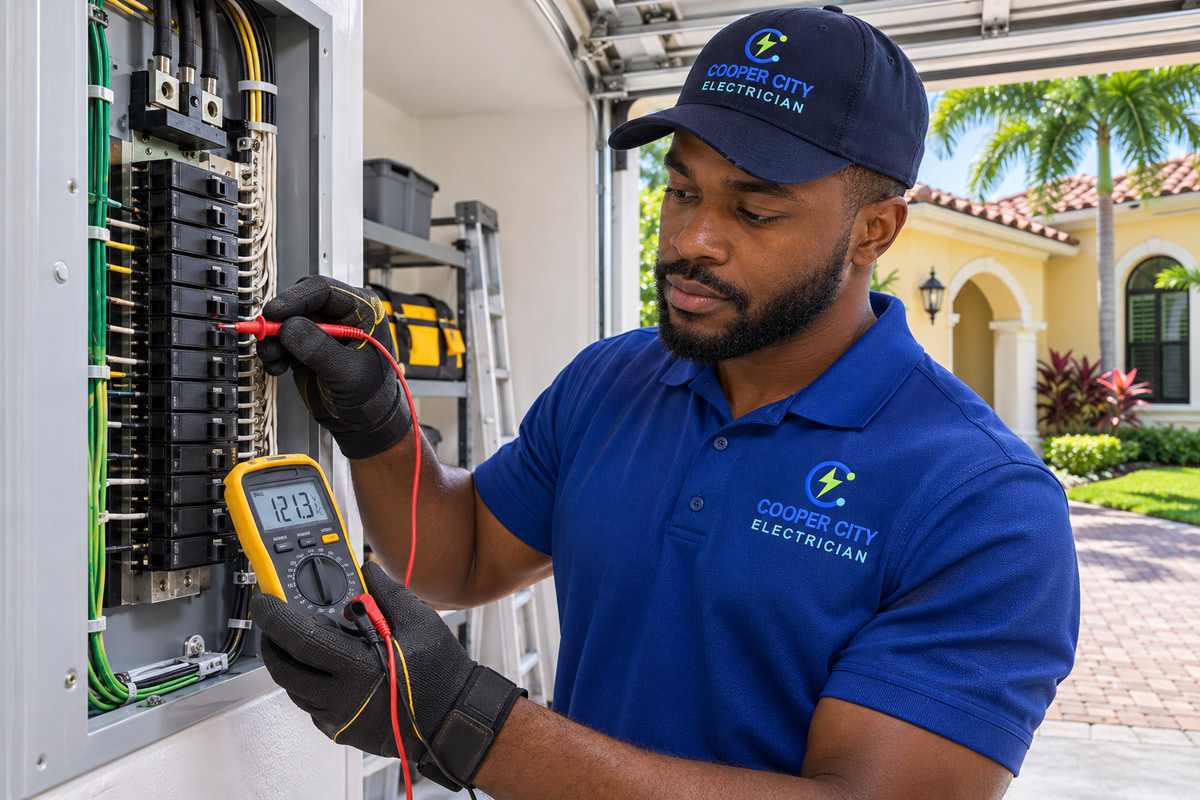
A panel in a Weston house is usually a modern breaker panel with a clear main breaker at the top and rows of smaller breakers below. When people open that door, they often think there is nothing to see. In reality there is quite a lot a careful person can learn without touching anything inside the box. Start with the label on the inside of the door. Is every circuit described in a way you can understand? A directory that says only room or misc tells you very little, and when a breaker trips at an awkward moment, a good label saves a lot of guessing.
Next, look at how full the panel is. Count the spaces. A panel with every slot taken has no room for a new dedicated circuit, and the only way to add one may be to combine two circuits into a special double breaker, which some panels allow and others do not. If you are planning something that needs its own circuit, such as a charger for an electric car, an outdoor kitchen, a second air conditioning system or a pool heater, the number of open spaces matters before the price of the equipment does.
Then consider the total picture. The main breaker rating sets the ceiling for everything running at once. A common mistake is to assume that a larger house automatically has a larger service. Some do, and some do not. Because Weston houses range from compact patio homes to large single family houses with pools and extra wings, it is worth confirming the actual rating on your main breaker rather than guessing from the size of the house. An electrician can do a load calculation that adds up what you have and what you want, using standard methods, and tell you plainly whether the service is comfortable, tight or in need of an upgrade.
Newer panels also contain protective devices that older ones lack. Some circuits in a modern house are meant to have arc fault protection, ground fault protection, or both, and those breakers have a test button. It is sensible to know which of your breakers have one. If a circuit trips repeatedly and has a protective breaker, that is often a sign of a real issue downstream, such as a damaged cord, a loose connection or a failing appliance, and it deserves a look instead of just resetting it over and over. Resetting a breaker that keeps tripping is like silencing a smoke alarm by removing the battery.
Finally, ask about surge protection at the panel. This is one of the most useful additions to a newer home, because modern electronics, appliances and air conditioner control boards are sensitive to voltage spikes. A protective device installed at the panel works for the whole house, and plug in strips then handle whatever remains. In a part of Florida with frequent thunderstorms, it is one of the more practical upgrades a homeowner can ask about, and it often goes in alongside other panel work in a single visit.
Outdoor living, lanais and the circuits behind them
Outdoor living is where many Weston electrical projects begin. The climate rewards it, and a lanai, patio or pool deck can become the most used room in the house for much of the year. The electrical needs of those spaces are different from indoor rooms, because the wiring has to survive moisture, heat, insects and the occasional wind driven rain. Equipment and fittings used outdoors are made for those conditions, and they are not interchangeable with what you would use in a hallway.
Start with lighting. Good outdoor lighting is mostly about placing light where people need it and keeping it out of their eyes. Steps, thresholds and walkways benefit from low, shielded fixtures. A dining area benefits from soft overhead light with a dimmer. Too many bright floodlights make a patio feel like a parking lot. A tidy plan usually has several small circuits or one circuit with switching by area, so you can light the grill without lighting the whole yard.
Ceiling fans on a covered lanai need boxes and fixtures rated for damp or wet locations, and the box must be built to hold a moving fan, not just a light. A fan that wobbles on a flimsy box is a nuisance at best. The same goes for outlets. Outdoor receptacles should have ground fault protection and weather resistant covers that protect the plug even while it is connected. A small gasketed cover that only closes when nothing is plugged in is not enough for a spot that will hold a holiday light cord for weeks.
An outdoor kitchen is a larger project. A built in grill with a side burner may use gas, but the refrigerator, lights, rotisserie motor and outlets still need power, and a kitchen of this kind usually wants its own dedicated circuit or two. Pool equipment adds another layer, because pumps, lights, heaters and salt systems each have specific wiring and bonding requirements. Bonding ties the metal parts around a pool together so that stray voltage cannot build up between them, and it is not something to improvise. This is work where permits and inspections matter, and where a qualified electrician should be involved from the start.
Finally, think about future flexibility. If you are already opening a wall or trenching a conduit to a detached area, adding a spare conduit costs little compared with digging again later. Many homeowners find that the second or third outdoor project, perhaps a hot tub, perhaps a shed with a workbench, would have been much easier if a spare conduit had been placed the first time. It is a cheap piece of foresight and one of the best questions to ask before the work begins.
Life near the edge of the Everglades
Weston sits near the edge of the Everglades, and that gives the area a particular character. Open land and water are not far away, the sky is wide, and summer thunderstorms can build quickly over the western side of the county. For an electrical system, the practical effects are lightning, wind, humidity and, in some spots, wildlife that finds its way into equipment.
Lightning is the biggest. A strike does not need to hit your house to cause damage. A strike nearby can send a surge down power lines, phone lines, cable lines and even through the ground. That is why surge protection works best as layers, with a device at the panel, protectors at sensitive equipment and, for some homes, protection on the air conditioning condenser. If an electrical storm has ever knocked out a garage door opener, a pool controller or a television in your home, that is a strong hint that your system would benefit from a protective plan.
Humidity is the quiet one. Moist air slowly corrodes metal contacts, and a panel in a garage or an outdoor meter enclosure sees more of it than a panel in a conditioned hallway. A good visit includes looking at the enclosure for rust, water stains or insect nests. Wasps and ants like electrical boxes, and the damage they cause is not always obvious from outside. Any outdoor enclosure should be closed, gasketed and sealed against gaps.
Wind and rain affect everything outdoors. Conduit and fixtures should be fastened firmly, and outdoor lights should be sealed against water entering from behind. A fixture that fills with water over a season of afternoon storms often fails in a way that trips a protective device, which can look like a mysterious problem with a whole circuit. Often the cure is a better gasket or a properly rated fixture, not a new breaker.
Storm preparation also includes the question of backup power. Some Weston owners want a generator or at least a way to connect one safely. A proper inlet and transfer arrangement lets a portable generator power selected circuits without back feeding the utility lines, which is dangerous for line workers and for your own equipment. Even if you never buy a generator, knowing which circuits you would want to keep running is a useful exercise: refrigerator, a few lights, internet equipment, a fan, and perhaps a medical device. Thinking it through in calm weather is much easier than doing it in a storm.
Planning the work around community rules and permits
Good electrical work begins with a plan, and in a planned city part of that plan is knowing the rules that apply to your property. Many communities have homeowner associations or architectural review requirements, and some of them care about exterior changes such as visible conduit, new fixtures, generators or meter area work. Before any exterior project, it is worth reading your community documents or asking the association what it needs to see. Doing that first avoids the unpleasant situation of finished work that has to be moved.
Permits are a separate matter. Many electrical projects, especially panel changes, new circuits, pool related work, service upgrades and generator connections, are expected to be permitted and inspected by the local building authority. A permit is not an annoyance to get around. It is a second set of eyes on safety critical work, and it creates a record that matters when you sell the house or file an insurance claim. Ask any electrician you are considering how permits are handled for the job, and treat vague answers as a reason to keep asking.
Scope is the next piece. A written description of what will be done, in ordinary language, protects both sides. It should say what is being installed, where, what is included such as a permit, patching and cleanup, and what is not. Prices are quoted after talking things through by phone, and complicated jobs need a look in person, because the real conditions in an attic, a garage wall or a panel box can change the plan. A quote given without seeing the situation should come with an honest note about what could change it.
Timing is worth planning too. Weston families often have school schedules, work from home arrangements and weekend routines. Work that shuts off power should be scheduled when the household can manage without it, and an electrician should tell you in advance which circuits will be off and for how long. For larger jobs, a utility coordination step may be needed, and that depends on the utility, not on the electrician, so allow some flexibility in your calendar.
Lastly, think about what you want to see when the work is finished. A clean job has labeled panels, tight covers, neat cable runs, tested ground fault and arc fault devices, and a short explanation of what was done. Ask the electrician to walk you through the panel directory and to show you where the shutoff is. If something is unclear, ask again. A good tradesperson would rather answer a question twice than leave you with something you do not understand in your own home.
Two Weston situations and how they might unfold
Examples help show how this works, so here are two situations typical of homes like those in Weston. They are illustrations, not records of particular customers.
The family that wants an outdoor kitchen. A household with a covered lanai and a pool decides to add a grill island, a small refrigerator and better lighting. The first step is a phone conversation to understand what they want. Then a visit to look at the panel, the available spaces, the path from the panel to the lanai and the existing outlets. The electrician finds that the panel has three open spaces, that the lanai has one old outlet on a shared circuit and that the pool equipment is on its own breaker. A plan emerges: one dedicated circuit for the refrigerator and outlets with ground fault protection, one lighting circuit with a dimmer and a spare conduit run to the island for future use. The permit is handled, the work is done in a day or two, and the family receives a plain summary of what each breaker now controls.
The household with a busy panel. A family in a house a few years old keeps tripping the breaker when the dryer and the microwave run together, and they want to add a car charger. A load calculation shows the main service is adequate but the panel has no open spaces. The electrician explains the options: a panel with more spaces, or certain space saving breakers if the panel allows them. They talk through the tradeoffs, the cost of each is quoted by phone after the visit, and the family chooses to replace the panel with a larger one and add a whole house surge device while the power is already off. The charger circuit goes in the same day, and the family now has room for a future addition.
Both situations share a pattern. The work starts with listening, moves to looking, and ends with a clear explanation. That pattern holds whether you are in a newer patio home near the Town Center area or a larger house closer to the open western edge of the city. Weston homeowners also live near neighbors with the same kinds of questions, so it is worth asking about what others in your community have done and whether any shared rules apply.
If you are not sure where your own project belongs, start with a conversation. Describe what you want, what you have noticed and what you are worried about. Weston is a city where houses are generally in good shape, and the best electrical work here is often about making a good system work better, safer and more comfortable for the way your family lives now.
Weston communities and what they have in common
Weston is made up of many separate communities, each with its own entrance, landscaping and style of home. Indian Trace and Bonaventure each have their own pages here because their houses and settings differ. Across the city, the shared thread is that most homes are newer, with modern grounded wiring and breaker panels. Within a single community, the houses are often built in similar years, so electrical needs such as panel space, lanai wiring and storm protection repeat from street to street.
Weston Town Center is a local shopping area, and many households run errands there, which makes it a convenient reference point when describing where you live. Closer to the western edge of the city, near the Everglades, storms and humidity can have more effect on outdoor equipment. If you are unsure how your community is built, describe the street and the general age of your house on the phone, and the conversation can start from there.
Nearby places we also help
Weston is close to several other places with their own pages. Read about Indian Trace and Bonaventure inside Weston, and about Pembroke Pines to the east. Cooper City is another family oriented suburb in the same part of Broward. For business needs, see our page on light commercial electrical work, and for advice on picking a contractor, see choosing an electrician you will not regret.